Why a Robust Network Is the Backbone of Every Modern AVL System
We received a call from a church because their livestream had been glitching and they could not figure out why.
The tech director was exhausted. The cameras were great. The audio console? State-of-the-art. The issue? It wasn’t a gear problem. It was a network problem. It couldn’t handle the traffic.
We see this all the time: You can have world-class lighting, stunning visuals, and powerful sound. But if your network isn’t built correctly, all of it is fragile.
At CSD, we’re watching a major shift take place across the entire audio, video, and lighting industry:
Everything is moving to AVoIP (Audio Video over IP).
That means your network is no longer just a support system in the background. It’s the foundation that every other system depends on. When it’s designed well, everything feels seamless. When it’s not, problems show up everywhere—dropped audio, sync issues, devices disappearing mid-service, or systems that simply can’t scale when new ideas emerge.
And here’s the reality:
If your network isn’t ready, it doesn’t matter how good the gear is.
We’re Not Just Designing for Today—We’re Designing for the Moment Creativity Shows Up
This happens more often than people expect.
A system gets installed. The team learns how to use it.
And then, once they see what’s possible, the ideas start flowing.
“What if we sent video to the lobby?”
“Could we route audio into another room?”
“We saw this at a conference… can we do our own version of that?”
Those are good questions. Healthy questions.
But too often, the answer becomes: “Not without rewiring everything.”
At CSD, we believe that’s a failure of infrastructure, not imagination.
When we design a network, we’re not just solving today’s needs. We’re building for where your ministry, your creativity, and your technology will be five to ten years from now. A robust network gives you the flexibility to try new things without tearing walls open or starting over.
If that foundation isn’t in place now, future ideas become expensive—or impossible.
Everything Is Talking to Everything—Over the Network
Today’s AVL systems don’t function as isolated components anymore. They’re interconnected and the network is what ties them together.
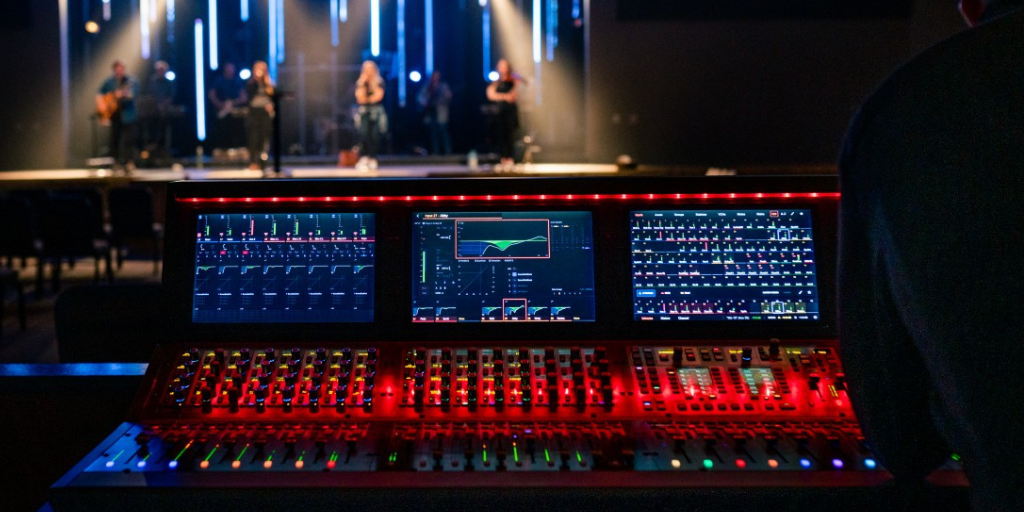
- Modern audio consoles communicate with stage racks and I/O via Dante, AVB, and other protocols running at Layer 2 or Layer 3.
- Many manufacturers now send audio directly to amplifiers over the network.
- Lighting fixtures—especially pixel-based and multi-cell fixtures—require networked data for control.
- Video systems increasingly rely on IP standards like SMPTE ST 2110 to move high-quality video, audio, and metadata.
- Control systems allow teams to walk an entire campus with an iPad, managing power, presets, and systems in real time.
These are not “best effort” data packets. They are time-sensitive AV streams that must stay synchronized.
Audio and video are often traveling as separate streams across the network. What keeps them aligned—so speech doesn’t drift out of sync or feel like a bad overdub—is Precision Time Protocol (PTP). That’s why professional AV networks also require properly configured multicast and IGMP, so critical AV traffic is prioritized and delivered reliably.
This level of performance doesn’t happen by accident. It has to be designed.
The Difference Between “It Works” and “It Works Every Time”
Many network problems don’t show up immediately. They appear under pressure—during a packed service, a major event, or a complex production moment.
Often, the root cause isn’t the console, camera, or lighting system.
It’s the network underneath.
One of the most important decisions is fiber.
Multimode fiber (OM3/OM4/OM5) can support very high data rates—including 10G, 40G, and even 100G—but only over relatively short distances. As bandwidth demands increase, distance limitations become a real constraint.
Copper still has its uses, and we’ve even seen IEEE standards push the limits of copper, such as Cat6A to 10GB of throughput. Copper can still be seen as the go-to for connectivity of devices to network switches, as many singular devices aren’t requiring bandwidth above the 1 GB, 2.5 GB, 10 GB requirements.
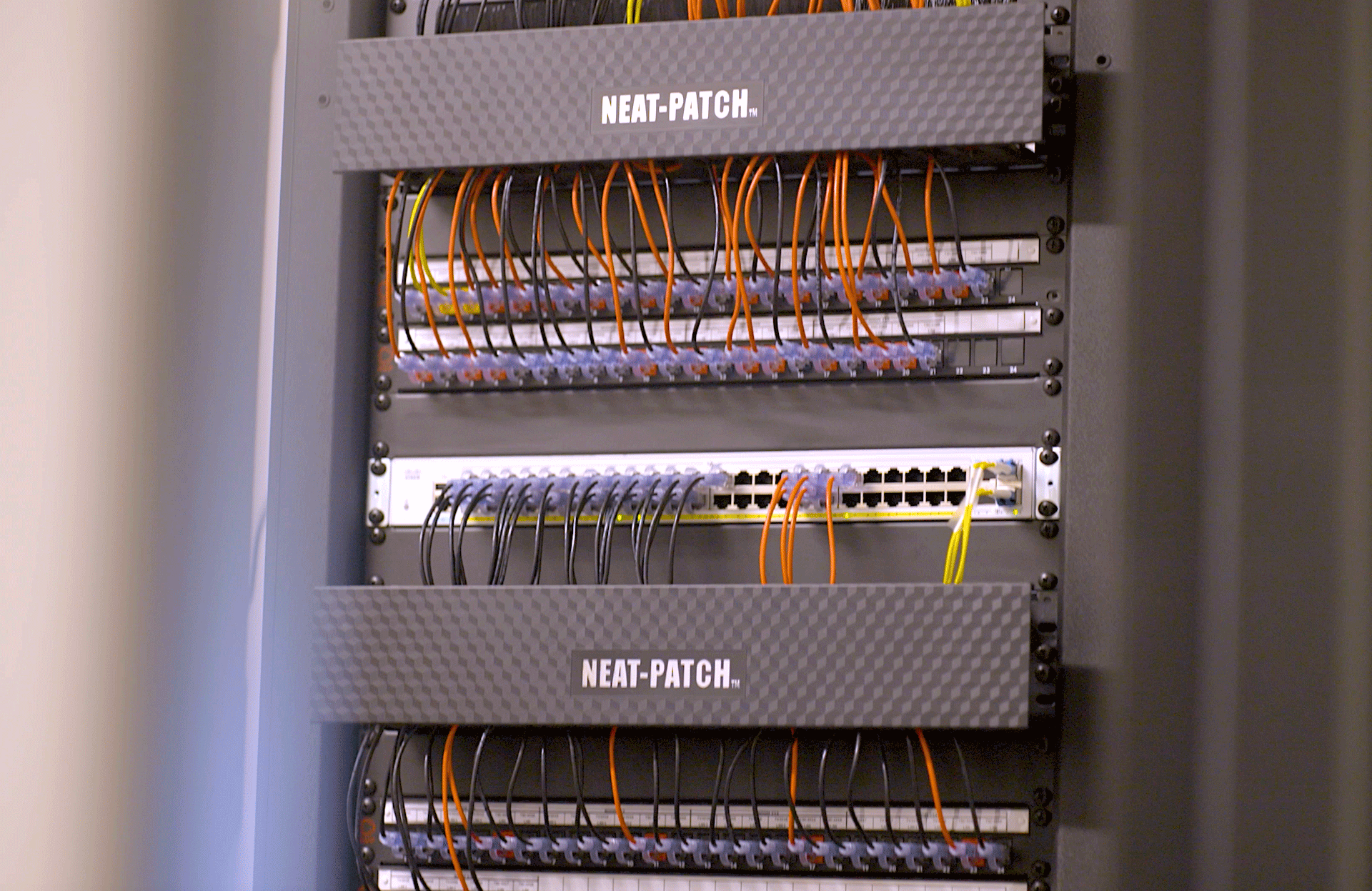
At CSD, we primarily deploy single‑mode fiber for backbone infrastructure. Single‑mode fiber supports extremely high data rates over long distances and scales far more effectively as technology evolves. There is no practical ceiling for future bandwidth needs when the right optics are used.
That’s why we routinely pull 12–24 strands of single‑mode fiber between buildings, front-of-house locations, and data racks. It’s not about today’s traffic—it’s about tomorrow’s possibilities.
The same philosophy applies to switching hardware.
Just because a switch claims it “supports Dante” doesn’t mean it’s appropriate for mission‑critical AV.
The other critical component CSD deploys is redundancy with throughput increases. We achieve this by setting up a LAG (Link Aggregation Group). A LAG combines multiple physical links into one logical link to increase bandwidth and provide redundancy. Think about adding lanes to a highway for more cars, not a faster single car. The throughput isn’t simply the sum of links for a single stream. Instead, a complex hashing algorithm distributes traffic flows across the links, allowing aggregate throughput to reach near-theoretical maximums while individual flows remain limited by a single link’s speed.
Professional AV networks require switches that allow deep configuration of VLANs, Quality of Service, multicast routing, and PTP. That’s why we use industry‑proven AV switches, such as the Netgear M4350 series. These platforms are built for real-world AV traffic, not just general data use.
Saving money on the wrong switch often costs far more later—in downtime, troubleshooting, and frustration.
Would a Church Need SMPTE 2110?
It’s a fair question.
SMPTE 2110 originated in broadcast environments, where uncompressed video, audio, and metadata must be transported with absolute precision. But churches and large venues are increasingly operating like media production facilities.
If your vision includes:
- Multi‑camera live production
- Routing video to overflow spaces or secondary venues
- Real‑time captioning or alternate language feeds
- High‑quality streaming and recording workflows
Then you’re already moving in the direction where 2110‑capable infrastructure makes sense—even if you’re not deploying it today.
The key is this:
If your network can’t support those workflows when the time comes, the creative opportunity disappears.
Designing a network that can handle this level of traffic ensures you’re ready when the system is turned on and the vision of what’s possible begins to grow among your team.
You Don’t Need to Be a Networking Expert—But Your Partner Does
Every week, forums are full of people troubleshooting Dante clocking issues, dropped devices, or unexplained clicks and pops. In most cases, the problem isn’t the audio gear—it’s the network design.
General IT networks are not built to prioritize time‑sensitive AV traffic by default. Even well‑meaning IT teams often lack experience with PTP, multicast, and AV‑specific network behavior.
At CSD, this is our specialty.
We’ve designed AV networks that have been running since 2019 with zero support calls. Not because nothing ever changed—but because the network was built correctly from the start.
We design networks so the goal is simple:
You shouldn’t have to think about them.
When the system just works, creativity can thrive—and stress disappears.
Build the Network That Makes the Future Possible
Here’s the reality we share with clients all the time:
If you want to use tomorrow’s technology, you need tomorrow’s network today.
A robust network doesn’t just make your system stable—it makes it flexible. It turns “What if?” into “We’re ready.” It allows your team to explore new ideas without fear of breaking something.
If you’re planning a new system—or wondering why your current one feels fragile—start with the network. It’s the most important system you’ll never see.
And when it’s done right, you’ll never have to think about it again.
- Dax Pogue, Client Relationship Manager , CSD